09 December 2011

Let's talk about Cambridge! - Laura Galea tells us about studying the Cambridge Literature Summer School program


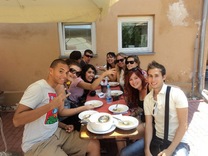
Laura Galea [pictured above], currently studying a Bachelor of Arts at Victoria University, embarked on the trip of a lifetime earlier this year when she participated in our
our Cambridge Literature Summer School program. Laura's AIM Overseas experience was so life-changing that she came back and transferred degrees as a result. Read on to find out more...

Why did you choose to study our Cambridge Literature Summer School program? I love the written word! Cambridge is a place where writers are kings, knowledge is currency, and inspiration is the air that we breathe in. Did I mention that I also love travelling?

Did you have any fears or concerns before doing the program?
My main concern was preparing myself academically; this meant doing all the preliminary reading and getting my hands on all the books that were needed to write ‘that’ essay. Other than that, I had only feelings of excitement and wonderment! I had so many questions: ‘How big were the classes going to be?' 'What kind of food would I be eating?' (and the most important question of all) 'Will there be enough time to party?!’


Tell me about a typical day at Cambridge.
I would wake up at 7am. Get ready, go to the dining hall (yes, it is as fancy as it sounds!) and eat breakfast. Class started at 9am and finished at 3:30pm. These classes included reading and discussing the classics and the greats of both English and Greek literature. I studied the Trouble with Keats, Making Sense of Poetry, and Homer’s The Odyssey and The Iliad.
Dinner was then served at 6:30pm. Cambridge are wonderful at doing all they can to distract you. There were poetry readings, Shakespeare plays, even the Alberni string quartet!
It was summertime. And you’re studying with people from all over the world – so I’m not going to lie to you and say there were no outings to the pub. Plus, we were in England!


Like a dream...

What was the highlight of the program for you?
The whole experience feels like a dream now, and sometimes I go back and read the emails that I sent out to family and friends and still get flutterbies. One of the many, many, many highlights was studying literature at a place where writing lives and has lived for hundreds and hundreds of years! Many of the writers that are taught at Cambridge (at some point or another) went to school and studied there, or taught there themselves. There is great pleasure in that. And knowing I was a part of that, even for just a little while, still makes me smile.


It's mind-boggling to think of how many of the world's literary greats have walked through these gates...

Do you have any funny travel stories you’d like to share?
Plenty! Most of them involve the Boston kids, copious amounts of bottles of Pimms, and going for (correction: trying to) punt.

There was a funny incident that actually happened before I arrived at Cambridge. I decided to plan a few days in London beforehand, to shop, shop, shop (what else?!) But as I got off the plane, I realised my phone had not been properly unlocked, and the new overseas sim that I had bought could not be activated, and therefore made me unreachable. This is a serious problem when you have your parents eagerly waiting by the phone to hear that you have arrived safely at your destination. Once I reached my hotel, the man behind the desk told me that there was a problem and that I had been moved to another hotel. It started pouring down rain, (of course!) and I had to walk to the next hotel which was twenty minutes away. By the time I reached the hotel, I looked like a drowned rat and the lady behind the desk asked, “Are you Laura Galea?”
“Yes.” I replied.
“Your mother called!”

Do you have some tips for someone who's going on this course?
1. Organise your sim card BEFORE you leave the country!
2. There are so many beautiful restaurants, cafes, and bars in Cambridge. Try not to limit yourself to eating in the dining hall. It’s such a gorgeous city!
3. Buy a bottle of Pimms, call your friends and go punting.


The real reason why our students love studying in the UK so much... PIMMS!

How has this program impacted you (either personally and/or professionally)? Before I left for Cambridge, I was in my second year studying a Bachelor of Education at Victoria University. Since coming back, I have transferred into a Bachelor of Arts – majoring in Literary Studies. I have changed my course around so that I can focus wholly on Literature, and hopefully do an Honours year after that. Teaching is very much still an option, but I’d like to explore this one first.

What would you say to somebody who’s thinking of doing the program?

Don’t worry about money.
Your university is there to help you. There are numerous scholarships you can look into, OS-HELP loans, etc.

Don’t worry about the workload. It is crazy and intense! But how often can you say you have travelled to the other side of the world to study at one of the most prestigious universities in the world?!

Don’t worry about being nervous. This is going to be one of the most AMAZING experiences of your life!!!!

Are you on the plane yet?


Cambridge awaits!


Laura even sent us in the office some little pressies before she left - thanks Laura! (Current/future AIM Overseas students take note: we really really really love candy!)

This program runs every year in the July uni holidays. To find out more about this program or to apply, please go to our website: www.aimoverseas.com.au or email us on info@aimoverseas.com.au

Join us on Facebook for more photos, travel tips and updates: www.facebook.com/aimoverseas

06 December 2011

Great travel advice from World Nomads

Hey AIM Overseasers, check out this awesome article from World Nomads on 9 Tips for Soaking up Culture on the Road: http://journals.worldnomads.com/travel-tips/story/81339/Worldwide/9-Tips-for-Soaking-up-Culture-on-the-Road

We can't wait to hear about your travel adventures!


This photo, taken on the European Marketing and Management Program in France, was a finalist in our Facebook photo tag competition earlier this year.

"It was like a dream!" - Judy Cheng on studying at the University of Cambridge


Judy Cheng [pictured above, centre] is currently completing a Bachelor of Biomedical Science at the University of Technology in Sydney. She's also a HUGE Harry Potter fan (this is relevant). In July this year, Judy embarked on the trip of a lifetime and set off to the University of Cambridge to study our Cambridge Science Program. Judy has kindly taken the time to tell us more about her summer of learning and travelling and the huge impact this experience has had on her. Read on...


Hi Judy! Could you please introduce yourself?
Hi, I’m Judy and I am an international student from Hong Kong. I am currently studying Bachelor of Biomedical Science at University of Technology Sydney (UTS). I will be finishing this degree in the middle of next year. This year in July, I have completed the Cambridge Science Summer Program term 1 [2 week long course] at the University of Cambridge.


Why did you choose this AIM Overseas course?
I chose this course because Cambridge is well-known for its science program and I am interested in Science. Charles Darwin, who is one of history’s greatest scientists, was a Cambridge student. Also, I have never been to Cambridge and hence I thought this would be an opportunity to explore the unique British culture. In addition, I had an unspecific elective (6 credit point) at UTS and so I applied for concurrent study and I got it!

Did you have any fears or concerns before doing the program?
Of course I had some! I was concerned about the safety as I was going to the other side of the world by myself. I was scared of bullies and robberies as I was a foreigner in their country. I was also afraid that I would not be able to meet anyone during the summer school program since English is not my first language.

How has doing this program affected you?
I met people from all over the world and if in the future they want to come to Sydney, I can show them around and be their tour guide! Also, I have become more confident in myself since I have shown myself that I am able to take care of myself on the other side of the world.

As for my English, I had to complete a 2000-word essay and received feedback from the lecturer – needless to say, my written English has improved a lot and so has my spoken English.

This program will be a great addition to my resume. I have shown that I am interested in international culture and am willing to adapt to a new environment. From an employee’s perspective, this would be a bonus compared to the other candidates.


Tell me about a typical day at Cambridge.
I lived in Gonville & Caius College right in the center of the town. Breakfast was served as buffet from around 7.45am to 9am. My favorites were coffee, eggs and sausages. Of course, you can have cereals, bread or yogurt. You can choose anything you want. During this time, I met a lot of people from different courses such as Shakespeare, History and Art summer schools.

My first and second lectures were ‘Impact and Responsibility’ which were in the morning. We had new content every day such as physics or biology. One day it would be about the light and the next it would be infection and autoimmunity. Even though my field of interest is Biomedical Science, my knowledge increased significantly during these lectures. You could also download some of the lecture slides on the intranet.

After this lecture, there was a 1.5-hour break. Hence I went out to have lunch with my new friends and we would walk around. My third lectures started at 2pm and this was a special subject course. When you applied for the Summer school in Cambridge, you needed to choose a special subject course from the list and I chose ‘From Atoms to Galaxies: the Astronomer’s View’. This topic was interesting and the lecturer, Robin Catchpole, was so nice. Even though we had a small class, around 8 people, he did not mind spending his time explaining everything to us and he was glad to repeat or further explain concepts for us.

When this class was finished, we had a few hours to ourselves. Some people did some sightseeing, but I needed to complete my essay since I had registered for the evaluation of the essay. Hence, I went to the library of my college (which was one of the most beautiful places at Cambridge!).


Gonville & Caius College Library. How can you not be inspired to do great things when you're studying in a place like this?!

Dinner was around 6.30 pm and it was a 3-meal course. Here’s an example of the meal.

Tuesday 12th July 2011

- Spiced Butternut Squash Soup or Aubergine Pate with Pitta Bread
- Homemade Shepherd’s Pie with Red Onion Gravy, Carrots, garden peas
- Sticky Toffee Pudding
- Coffee

Sounds good, right?

Evening lectures started at 8pm and finished at 9.30pm. Different topics were included not only from the Sciences but also from Art or Literature (such as the plays of Shakespeare etc.). It was a bit difficult for me since I did not have any knowledge of Shakespeare, but these lectures were interesting.

Here’s a short version of my daily schedule.

Breakfast - 7.45am-9.00am
1st Lecture - 9.15am-10.30am
2nd Lecture - 11am-12.30pm
Lunch - 12.30pm – 2.00pm
3rd lecture - 2.00pm-3.30pm
Free time - 3.30pm – 8.00pm
Dinner - 6.30pm – 7.45pm
4th lecture - 8.00pm-9.30pm


What was the highlight of the program for you?
That would be the travelling. My friends and I went to places such as Oxford. I was so excited since I could go to the place where Harry Potter was filmed. It was a shame that I didn’t have a lot of time and couldn’t stay longer; still, I was so glad I got to go there and took lots of photos!

Another trip which was so inspiring was the additional trip with the lecturer. As I mentioned before, Robin Catchpole was my lecturer of the special course, astronomy. We were so interested in this area that we even asked him if he would show us around the institute of Astronomy in the University of Cambridge. He agreed and afterwards he had planned the whole trip. At the beginning he led us to the library and one of his colleagues told us about the history of astronomy. Then Robin showed us around the institute and explained everything. It was one of the most amazing times I have ever had!

Did you do some extra travel before/after/during the program?
Yes. Before the program, I went to Reading to attend my friend’s graduation. We also went to Bath and Scotland for several days. It was like a dream, travelling with your friends in a foreign country. Seriously, if I did not apply for this program, I would not have been able to meet my friend and hang out with him in England.

After the program, I stayed in London for a few days by myself and did some shopping. Sometimes the best way to truly understand the culture is to stay at one place for a while, soon you will notice the difference and you will start to enjoy it.

Do you have any funny travel stories you’d like to share?
During the weekend, I went to the optional weekend excursion which was London city cruise. While we were in London, the weather was so funny. It was raining heavily for 10 minutes and it was sunny for another 10 minutes and then it was raining again. The weather kept changing for at least an hour. I still remember people around me kept complaining. As for me, I enjoyed it. It was something different!

Do you have any advice for students thinking about doing this course?
I would suggest you to read all the information regarding the special subject courses.

You also need to consider that if you are hoping to register for the elevation of the essay, the course will be more intense since you need to complete a 2000-3000 word essay in a week. However, it’s worth it!

As for international students studying in Australia, you need to provide your IELTS result or attend a Cambridge language Centre diagnostic assessment before the University of Cambridge considers your application.

What would you say to somebody who’s thinking of doing the program?
I would highly recommend this course. When you are back from Cambridge, you will have more friends than before and start to realise the cultural differences. You will also gain additional knowledge from the learning. The optional weekend excursion is good for meeting people as you and your new friends can explore the place together.

As for international students who are studying in an Australian university, if you can study in Australia, I believe you have the ability to study in Cambridge. There is a similarity between Australia and Cambridge and that is - ENGLISH is the spoken language.

And most importantly, Cambridge is only 3 hours away from Oxford - you might be able to see the place where Harry Potter was filmed!

Thanks Judy, sounds like you had a fabulous time!


Judy and her new friends at the Farewell Dinner. Parting is such sweet sorrow!


Judy and friends on the London city cruise. What a summer!

This program runs every year in the July uni holidays. To find out more about this program or to apply, please go to our website: www.aimoverseas.com.au or email us on info@aimoverseas.com.au


Join us on Facebook for more photos, travel tips and updates: www.facebook.com/aimoverseas

05 December 2011

Global Leadership Program: applications now open for July 2012

GLP
Now in its 13th year, the Global Leadership Program in Prague is an intensive academic program with participants from all around the world taking part.

Open to students from all discipline backgrounds, this prestigious program includes academic classes (Philosophies of
Leadership, Global Business, Human Rights, Social Entrepreneurship and Media, Democracy and Development), as well as cultural activities, field trips and community work.

Workshops give you an opportunity to learn practical skills such public speaking, writing a business plan and how to implement a project in your home community. Limited places offered to participants from around the world so apply early to avoid missing out.
Read more


"This was a life changing experience! I never thought that I'd have the chance to spend the summer in one of the most beautiful cities in Europe. I now have a different view on leadership and life and also many new life long friends!"
Marcus Raty [pictured left], Griffith University, 2011 participant. Read full interview


Credit and funding

*This program may be able to count for credit towards your degree. More info


*Over $5800 in Government funding may be available for eligible students. More info on the OS-HELP website.


Limited places, apply early!
Early-bird discounts available


Photos from past participants:


We are currently accepting applications for this program for July 2012.
*To find out more about this program, go to our website:
www.aimoverseas.com.au or email us on info@aimoverseas.com.au
*To apply, fill out this application form


Places for this program are strictly limited, so apply early to avoid missing out.


Join us on Facebook for more photos, travel tips and updates: www.facebook.com/aimoverseas

01 December 2011

Passport to hassle-free transactions: Sydney Morning Herald article by John Kavanagh

Published in the Sydney Morning Herald on November 30, 2011
Article by John Kavanagh
Access original page here: http://www.smh.com.au/money/passport-to-hasslefree-transactions-20111129-1o3sb.html

Eiffel Tower.

Unclouded … buying foreign currency, travellers cheques or a travel card locks in your exchange rate. Photo: Louie Douvis

Should you take credit cards, debit cards, travel cards or travellers' cheques? John Kavanagh does the homework for you.

Australians are flocking overseas in record numbers thanks to a strong Australian dollar. The growing trend has prompted banks and financial institutions to upgrade their travel money services and offer more competitively priced products. It's not surprising given Australians are the biggest travel spenders worldwide.

Each month the Australian Bureau of Statistics calculates what it calls short-term movement resident departures; that's us going overseas for holidays and business trips.

More than 600,000 people a month have hopped on a plane or a boat so far this year. The number was 665,100 in September. That number has been rising steadily over the years. In 2007, a year when people were feeling very prosperous, about 450,000 a month were going overseas. A decade ago the number was about 290,000 a month.
Advertisement: Story continues below

Australians spent an average of $US3636 during their last overseas trip, making them the biggest travel spenders worldwide, according to a Visa survey published in September.

Australian respondents to the Visa Global Travel Intentions Survey say they are planning an average of three international trips in the next two years, spending an average of 16 nights on their next holiday.

In the financial world, the providers of specialist travel money products are competing hard to capture a share of that fast-growing market.

It has lowered the costs of buying foreign currency and making transactions abroad.

Specialist travel money products and services are also finding their way into everyday transaction and credit card accounts, giving consumers the option of setting up a permanent banking facility that will also cover travel needs.

AMEX BOOTHS

American Express, which has a long-standing agency arrangement with Australia Post for the sale for foreign currency, travellers cheques and travel cards, is now putting its own staff into Australia Post outlets to operate stand-alone Amex service counters.

The first of the new Amex booths opened in the Brisbane GPO this week and the company plans to open 200 of them over the next two years.

Last year Amex launched its GlobalTravel Card, a rival to the Travelex Cash Passport and similar cards offered by banks. Its card has no expiry date and no inactivity fee. There is no commission charge if it is bought at a post office.

Commonwealth Bank has upgraded its Travel Money Card to allow travellers to load multiple currencies on one card.

At the same time, a number of banks have incorporated a wider range of travel and foreign exchange services into everyday transaction and credit card accounts, with the aim of allowing customers to use those accounts when they travel overseas.

EXTRA SWEETENERS

In October, Citibank removed fees for overseas ATM withdrawals, overseas point-of-sale transactions and overseas funds transfers (to other Citibank accounts) from its Citibank Plus Transaction Account.

Citibank launched a new credit card, Signature, which includes international and domestic travel insurance and two airport lounge passes each year.

The card's rewards program includes four points for each dollar spent overseas, compared with 1.5 points for each dollar spent in Australia.

HSBC Bank Australia has launched a 24-hour foreign exchange trading service with live pricing. The service, Get Rate, is for retail and small-business customers. HSBC is claiming its 24-hour live pricing service is a first in the retail and small- and medium-enterprise markets. Available via mobile and online banking platforms, Get Rate offers access to 19 currencies.

In August HSBC launched a Platinum Qantas Visa Card, offering two points for each dollar spent overseas (compared with one point for local purchases), complimentary passes to the Qantas Club, travel insurance and purchase-protection insurance.

The question for travellers is whether they should shop for travel money products or find an everyday transaction account and credit card that will also meet their travel needs.

MIXED WALLET

The head of transaction services at Citibank, Sarah Black, says: "We have a transaction account that you can use anywhere. The proposition we would put to customers is that you don't need other products for travel."

The head of foreign exchange services at American Express, Nick Dinopoulos, says: "When considering a choice of bank transaction account and credit card versus travel money products, a big issue is certainty.''

When you buy foreign currency, travellers cheques or a travel card you have locked in your exchange rate.

"Having the foreign currency locked in allows you to budget and gives you peace of mind,'' Dinopoulos says.

"We recommend a mix. We are the largest wholesaler of banknotes in the Australian market and we can report that cash is king for travellers.

People like it for acceptance and liquidity. And it is cheap - once you have the cash there are no transaction fees.

"Our card product is growing share of wallet. Cheques are declining but are still a powerful product."

One of the significant changes that will result from Amex's move to have its own staff operating sales booths in post offices is that customers will get "instant fulfilment". Under the current agency arrangement, customers order their travel money product and come back a few days later to pick it up.

Now they will get their currency, cheques or card without any delay.

"Customers feel inconvenienced if they have to come back to pick up their travel money," Dinopoulos says.

There is no commission when any of those products are purchased through post offices and that aspect will continue under the new Amex arrangement.

COSTS

The head of retail banking and wealth management at HSBC Australia, Graham Heunis, says he understands that some travellers want the security of knowing exactly how much spending money they will have when they travel.

"For some people, having certainty and the ability to budget is a valid issue,'' Heunis says. ''But others prefer to be able to use their own transaction account and credit card wherever they are. That gives them a lot of flexibility and convenience.

"When I travel, I take a little cash, my debit card and my credit card. We see a growing number of our customers doing it that way."

The head of savings and investments at HSBC, Michael Danby, says customers use the service as part of their travel planning and overseas shopping.

"Customers like the fact that it is the same type of account as their Australian dollar account, with the same online access. You can use it to send foreign currency wherever you like," he says.

Comparison site RateCity says another important issue to consider when choosing from among the various travel money options is the cost of the service.

For travel card users, costs can include a purchase price of as much as $15, reload charges, ATM fees and inactivity fees.

For users of debit cards, costs include currency-conversion fees of as much as 3 per cent (ANZ and Commonwealth Bank) and ATM withdrawal fees of as much as $5.

Users of credit cards also pay currency-conversion fees and ATM fees. However not all card issuers apply these charges.

Travel money tips

❏ Notify your bank before you go.

❏ Some countries have moved to chip technology that requires a PIN, not signatures, for transactions.

❏ Keep a copy of the customer service numbers of your service providers.

❏ Check for daily withdrawal restrictions in your destination.

❏ Do not keep all cash, cards and cheques in one place.

❏ Ensure if you are robbed or lose your wallet you don't lose all your travel money.

❏ Keep a copy of all receipts to check against your statements.

Different countries require different approaches

University student David O'Brian, 22, made his first trip overseas two years ago, when he travelled to England and Europe. Last summer he visited South America and this summer he will be holidaying in Thailand and Cambodia.

For his first trip, O'Brian used a Travel Money Card from the Commonwealth Bank. When he left Sydney he had pounds for his short stay in England and euros for his stay on the Continent.

He found he could use the card everywhere without problems.

For his trip to South America he took US dollars and a travel card. But he took a lot more cash on this occasion because he had been advised that ATMs might be hard to find.

He is still considering how he will organise his money for his trip to Asia. He will visit rural areas in both Thailand and Cambodia and expects that he will need a fair bit of cash.

"I have read some guides that say it is best to have a combination of US dollars and Thai baht,'' he says. ''I'm worried that Asia could be an iffy place as far as security goes, so I don't want to carry a lot of cash.''

But he's not sure about taking a travel card. ''In Europe I probably spent close to $100 on transaction fees,'' he says. ''Unless I'm taking a lot, I don't know if I want to go through the hassle and the expense of a card. I forgot my PIN code a couple of times in Europe.''

O'Brian does not have a credit card. He doesn't like the idea of spending borrowed money. In any case, travelling with friends means if he runs short, one of them can help out.

Different options: fees and features

❏ American Express Global Travel Card. Three currencies available. Costs up to $15 to buy and up to $10 to reload. ATM fees are $US2, €2.20 and £1.25. A distinctive feature of the card is that it does not expire and there are no inactivity fees. Emergency card replacement and cash are available worldwide for peace of mind.

❏ Travelex Cash Passport. Five currencies available. Costs up to 1.1 per cent to buy and 1 per cent to reload. ATM fees are $US2.25, €2.20 and £1.50. Funds may be forfeited if the card expires and there may be monthly inactivity fees. A distinctive feature is the card can be reloaded via SMS. Emergency assistance is available.

❏ ANZ Travel Card. Six currencies available. Costs $11 to buy and 1.1 per cent to reload. ATM fees are $US2.20, €2.10 and £1.25. Funds will be retained by ANZ 12 months after card expiry and there are inactivity fees. Limits apply for daily spending. A replacement card is available at a cost of $35 but there is no other emergency assistance.

❏ Commonwealth Bank Travel Money Card. Nine currencies available. Costs $15 to buy and 1 per cent to reload. There is a $60 card-replacement fee. ATM fees are $2.50, €2.20 and £2. Funds may be forfeited if the card expires and there are inactivity fees. But there are no fees for closure. There are ATM balance inquiry fees and SMS alert fees. Emergency assistance is limited. A feature of the card is that it can load multiple currencies.

SOME GOOD DEALS

❏ The Citibank Plus transaction account has no fees for overseas ATM or point-of-sale transactions.

❏ Other debit cards with no overseas ATM or currency conversion fees include NAB's Gold Banking account, Hume Building Society's All Purpose account and ECU Australia's Access Plus account.

❏ The GE Money 28 Degrees MasterCard credit card has no ATM charges or currency conversion fees.

❏ ING Direct's Orange Everyday transaction account, which is fee-free for local banking, has a low $2.50 charge for international ATMs.

❏ ANZ is developing foreign exchange ATMs that will issue US dollars, New Zealand dollars, pounds and euros.

Read more: http://www.smh.com.au/money/passport-to-hasslefree-transactions-20111129-1o3sb.html#ixzz1fELjd0LQ


  © Blogger template 'Isolation' by Ourblogtemplates.com 2008

Back to TOP